ERP and Online Store Disconnected? 5 Signs It’s Time to Integrate Them
Is your eCommerce operation a mess? Avoid stock errors and shipping delays with ERP integration. Discover the 5 warning signs that it’s time to automate, scale your business seamlessly, and boost your team’s productivity.
 Patricia Fernández·
05 ene 2026·
5 min
Patricia Fernández·
05 ene 2026·
5 min
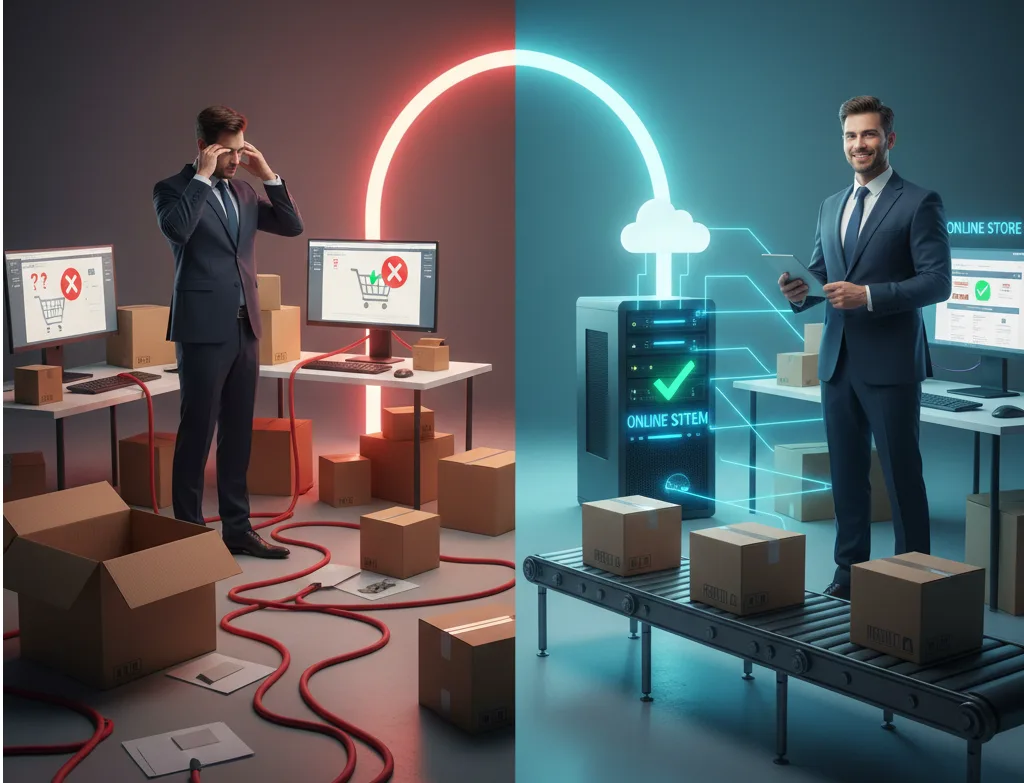
Do you feel like your eCommerce operation is getting more complicated every day? In the digital age, having an online store is only the first step. The real challenge for small and medium-sized enterprises (SMEs) is not just selling online, but doing so efficiently, profitably, and scalably. As your business grows, manual tasks that were once manageable quickly become a bottleneck that stifles your potential.
If you feel your team spends more time putting out operational fires than focusing on growth strategies, it is highly likely you need an integration between your Enterprise Resource Planning (ERP) system and your eCommerce platform. Ignoring these signs not only affects your productivity but can also damage your brand reputation. Below, we explore the 5 red flags indicating that your business needs this synchronization urgently.
1. Constant Inventory Errors
This is perhaps the most common and damaging sign. It happens when your store shows available units, a customer makes a purchase, and only then does your team realize the product sold out earlier through another channel. This "ghost stockout" is a recipe for disaster, leading to frustrated customers, cancellations, and refunds that hurt both your cash flow and your reputation.
Manually keeping inventory up to date is practically impossible if you sell across multiple channels, such as a physical store and marketplaces. An effective integration allows every sale, regardless of where it occurs, to update stock levels instantaneously across all your platforms. This prevents products you actually have in the warehouse from appearing as "out of stock" simply due to a lack of updates.
2. Slow Order Processing and Human Error
As sales volume increases, the "copy and paste" method of moving information from the online store to the billing system becomes unsustainable. This manual process not only delays shipments but also opens the door to costly human errors, such as mistyping a shipping address or an SKU.
Order automation eliminates this chaos. As soon as a customer clicks "buy," the order is automatically created in your ERP with precise information, ready to be dispatched. This improves the customer experience, as they receive real-time updates on their package status without an employee having to notify them manually.
3. Lack of Insight into Customers and Sales
Having a 360-degree view of your business is essential for strategic decision-making. If answering which product is your best-seller requires crossing three different spreadsheets, you are operating blindly. A lack of integration often leads to duplicate or outdated customer data, preventing you from creating effective loyalty programs or segmented promotions.
By centralizing information, purchase histories and order details are synchronized in one place. This not only simplifies daily management but also allows you to use data analysis tools to uncover valuable insights, transforming isolated data into a real competitive advantage.
4. Endless Financial Reconciliation and Invoicing
Month-end closing is a nightmare when the accounting team must manually reconcile payment gateway income with store orders and administrative system invoices. This process is a minefield of discrepancies where totals rarely match on the first try, complicating accounting and tax filings.
A robust integration automates invoice generation as soon as a payment is confirmed. This ensures every sale is recorded correctly and simplifies bank reconciliation, providing you with an accurate, real-time financial overview. You will no longer have to worry about invoices with incorrect amounts or mistyped tax data.
5. A Team Overburdened with Repetitive Tasks
The most human sign is the morale of your collaborators. If your team is constantly stressed and overwhelmed by monotonous tasks, their talent is being wasted. High staff turnover is often a direct consequence of frustrating manual processes that prevent employees from focusing on what truly matters: the customer.
When integration takes over data entry, you free your team to perform high-value activities. An automated company is not only more efficient but also creates a more motivating work environment where growth is seen as an opportunity rather than an unbearable workload.
Conclusion
If you identified with two or more of these signs, your operation has outgrown your manual processes. Integrating your ERP with your online store is not a technological luxury; it is a fundamental investment for any SME aspiring to grow sustainably.
Tools like ERPXtender are designed specifically to bridge this gap, allowing systems like Bind ERP and WooCommerce to work in perfect harmony so you can scale without limits.